Shame and the Addict

The light of the full moon, the blaze of its spirit which is ours yet not ours, which connects all people young and old, living and dead, both gone and not gone, takes on a new significance in the southern hemisphere. Not only is the full moon in the opposite sign to the sun, but in southern hemisphere astrology it is in the same sign as the sun in the northern hemisphere.

This month there are two full moons: the first was in sidereal Sagittarius; the second, on the 31st, will be in Capricorn. These are both northern hemisphere winter signs, and there is no need to remind you that it is winter here in southern Australia. And yet these constellations are very high in the sky, exalted if you will, so that the moon’s light is the brightest of the year. It illuminates every nook and cranny.
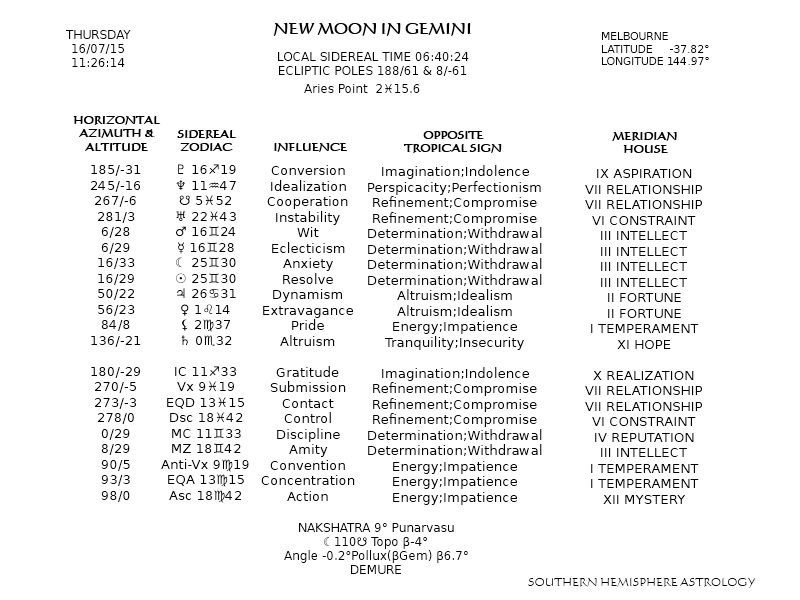
New Moon Jul 16This new moon on Thursday, 4° above the sun, is in Gemini, associated here with the winter characteristics determination and withdrawal. That it occurs in the house of the mind resonates with those seasonal characteristics, as well as with the northern sidereal character of Gemini, and the northern tropical character of Cancer. We will see its first crescent in the wastes of Cancer on Friday, weather permitting.

How does the moon make a fresh start with determination and withdrawal? The sun is a poor parent in this sign. The moon finds little or no mirror in it. It can’t wait to get out, transforming negativity and shame along the path of least resistance, service to the world, or ‘fix it’ mode. It will immediately find itself in a clearing with a golden orb spider and a giant snake, but life wasn’t meant to be easy.

It all comes good in the end, or does it? There’s a tendency to vanity I worry about, and the signs it must cross threaten confusion, impatience, insecurity, mind-games and laziness. All this negativity, to compound a poor kid’s defences against a withdrawn parent!

Where does shame come in, and why do I call this moon The Addict? In a way, I’m a little ashamed to bring it up, but I believe shame to be a fundamental element of socialisation, and everywhere I look I identify defences against it: the need to not seem needy, and its oppressive projection; and the creepy steps taken to not be seen as creepy, are just two examples. Whether or not this sun shames the moon to leave her alone, or this moon is ashamed of his parent, there can be no doubt that venturing into society without a guide will occasion plenty of shame.

Wikipedia has an excellent entry on shame. Of particular interest is the connection it suggests between shame and narcissism:

“It has been suggested that narcissism in adults is related to defenses against shame and that narcissistic personality disorder is connected to shame as well. Psychiatrist Glen Gabbard suggested that NPD could be broken down into two subtypes, a grandiose, arrogant, thick-skinned “oblivious” subtype and an easily hurt, oversensitive, ashamed “hypervigilant” subtype. The oblivious subtype presents for admiration, envy, and appreciation a grandiose self that is the antithesis of a weak internalized self which hides in shame, while the hypervigilant subtype neutralizes devaluation by seeing others as unjust abusers.”

https://en.m.wikipedia.org/wiki/Shame
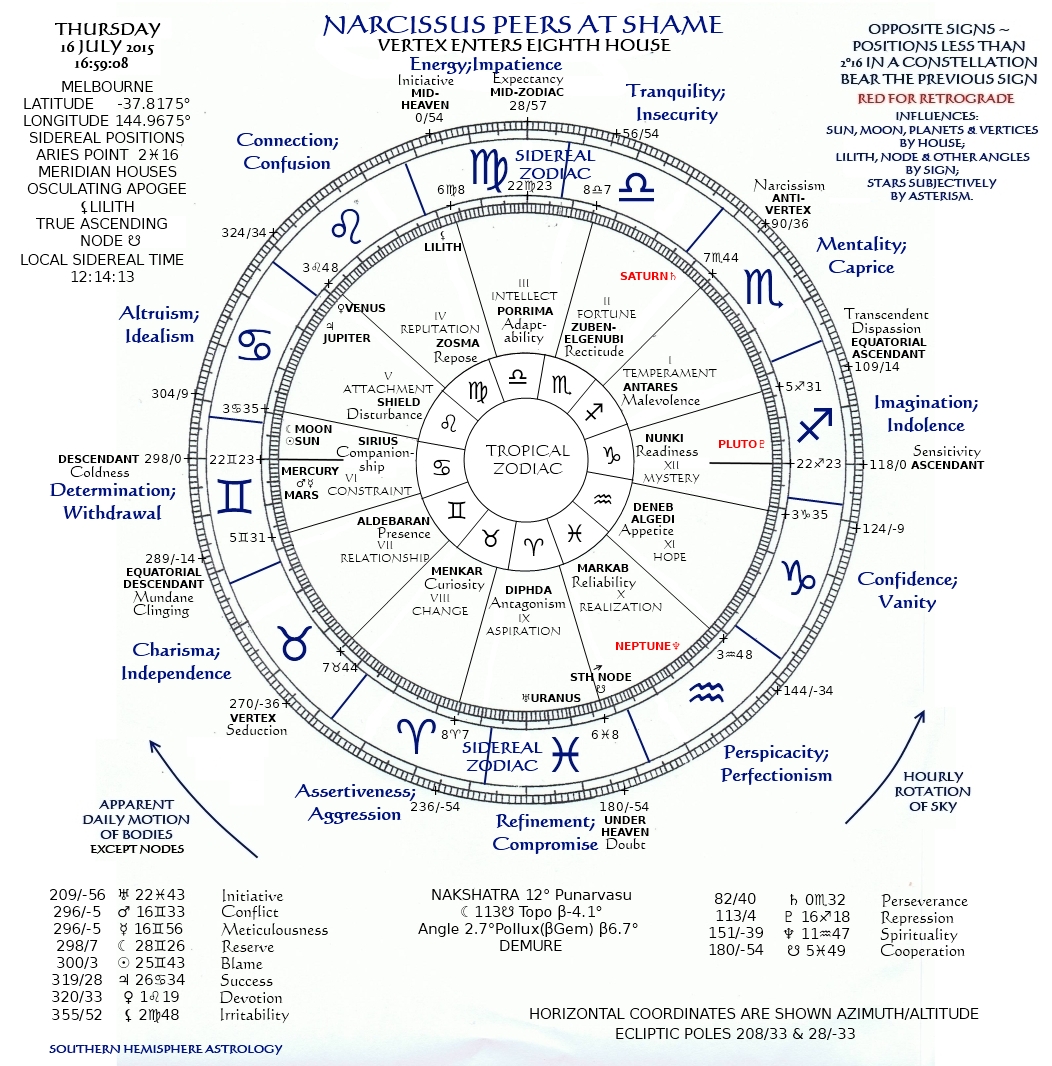
Vertex Enters Eighth House Melbourne Jul16The moon in Thursday’s horoscope is already nearly 3° past new, but the time is ripe for self-awareness, sunset, sun and moon are in the house of constraint, the zodiac is aligned emphatically east with the personal, the ascendant is in the house of mystery, and the vertex is entering the eighth house. Mars and Mercury are in the tightest conjunction, but where they can’t be seen.

I feel a lot of compassion for this moon. Perfectionists, ideologues, alcoholics, addicts of all types, ashamed or defending against shame, this moon shines on us!
In the Middle of the Endocrine Night

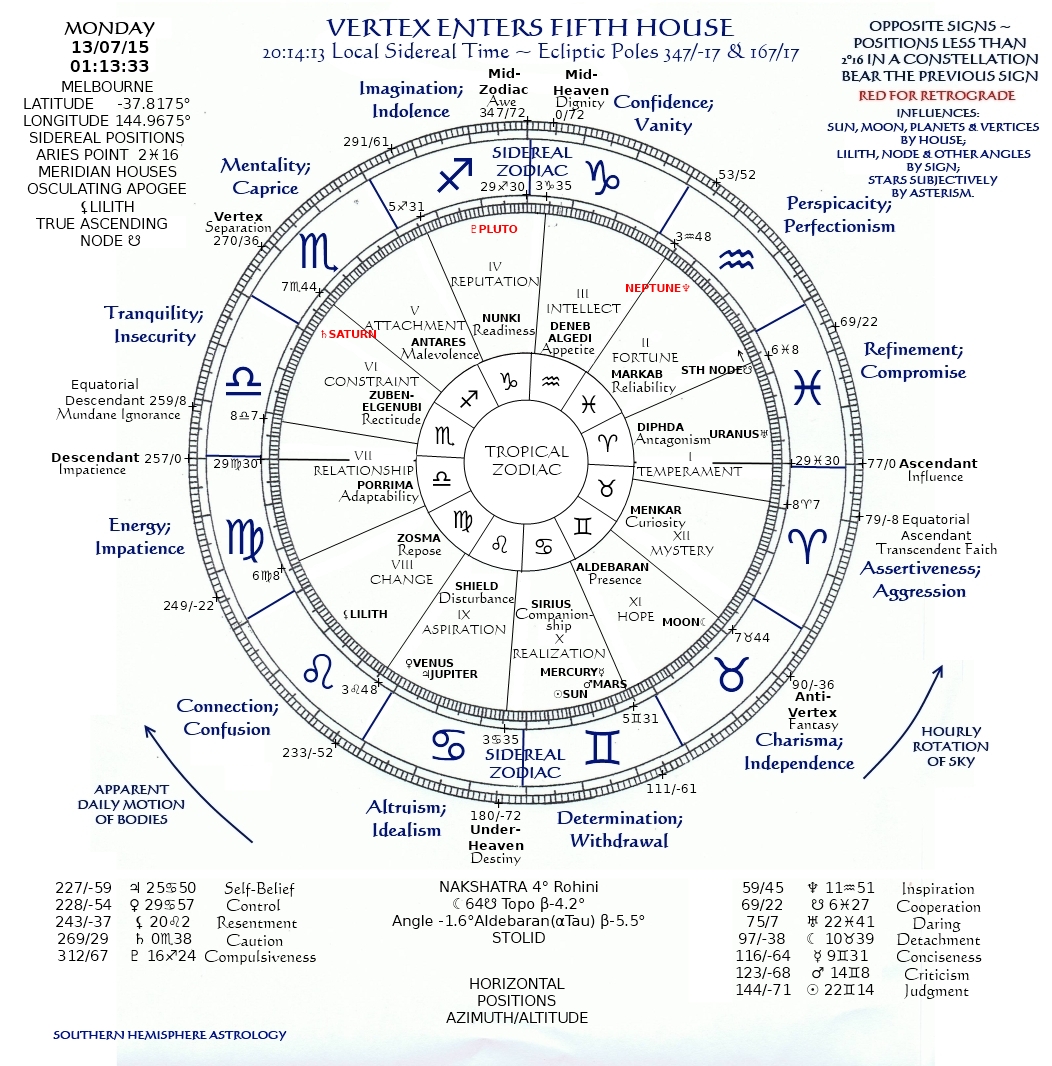
Perhaps recent interest in the Vertex and its association with that ‘special someone’ is pure fabrication, confirming astrology’s reliance on confirmation bias. The angles in the chart below repeat every 23 hours 56 minutes and 4 seconds, like the position of stars. They cannot rationally be connected with the behaviour of the human soma, since they occur in the middle of the day in summer, the morning in autumn, and the evening in spring.

Or can they?

“Sometimes, too, just as Eve was created from a rib of Adam, so a woman would come into existence while I was sleeping…. Formed by the appetite that I was on the point of gratifying, she it was, I imagined, who offered me that gratification. My body, conscious that its own warmth was permeating hers, would strive to become one with her, and I would awake. The rest of humanity seemed very remote in comparison with this woman whose company I had left but a moment ago: my cheek was still warm with her kiss, my body bent beneath the weight of hers. If, as would sometimes happen, she had the appearance of some woman whom I had known in waking hours, I would abandon myself altogether to the sole quest of her, like people who set out on a journey to see with their own eyes some city that they have always longed to visit, and imagine that they can taste in reality what has charmed their fancy. And then, gradually, the memory of her would dissolve and vanish, until I had forgotten the maiden of my dream.”

Marcel Proust, Remembrance of Things Past, trans. C.K. Scott Moncrieff.

Vertex Enters Fifth House Melbourne July13

Vertex in the Eighth House

Perhaps the glimpse of something at the rear of a boutique, an aroma wafting up from a subterranean kitchen, the way the good-looking young man looked at you back there as he laughed gaily with the vendor, or a nose, an ear, the globes of a shapely bottom, breaks the spell which has bound you, as you find yourself walking briskly after work to the station, realising that you are dissatisfied, tired, cold, hungry and alone.

Listen again to the words of this song. If it speaks to you, hurry home, for God’s sake, Ladybird!

“And if she says come inside
I’ll come inside for her
And if she says give it all
I’ll give everything to her
I am justified
I am purified
I am sanctified
Inside you.”

No reverie! Read the news, an editorial perhaps, or the sports pages, but no culture or lifestyle. Under no circumstances detour from the station, call into your local or visit a neighbour. You are in grave danger at this hour—for the remainder of the winter.

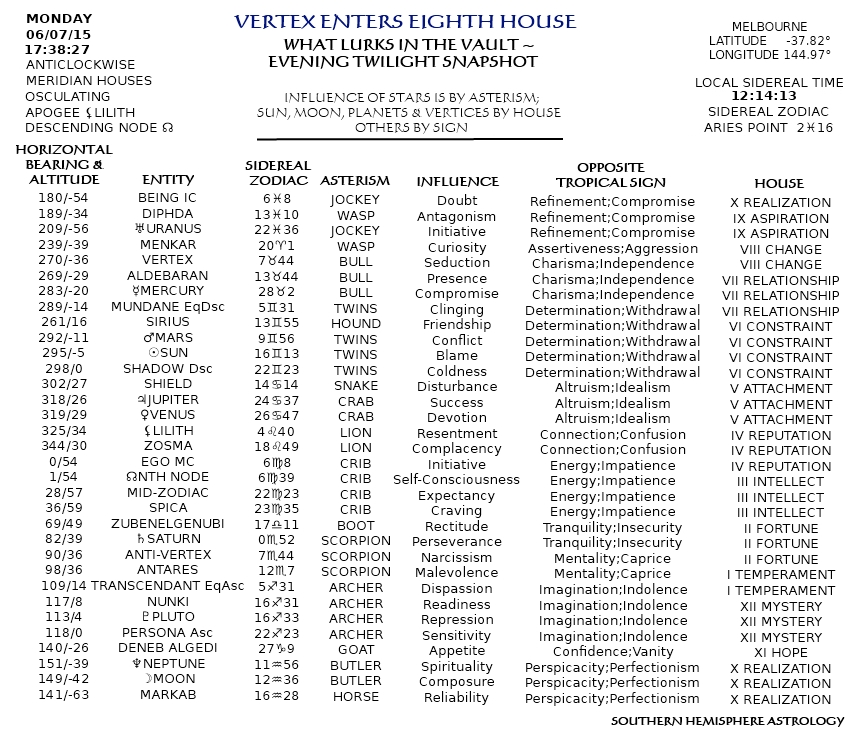
Yes, the Vertex has entered the eighth house.Evening Twilight Snapshot Jul06

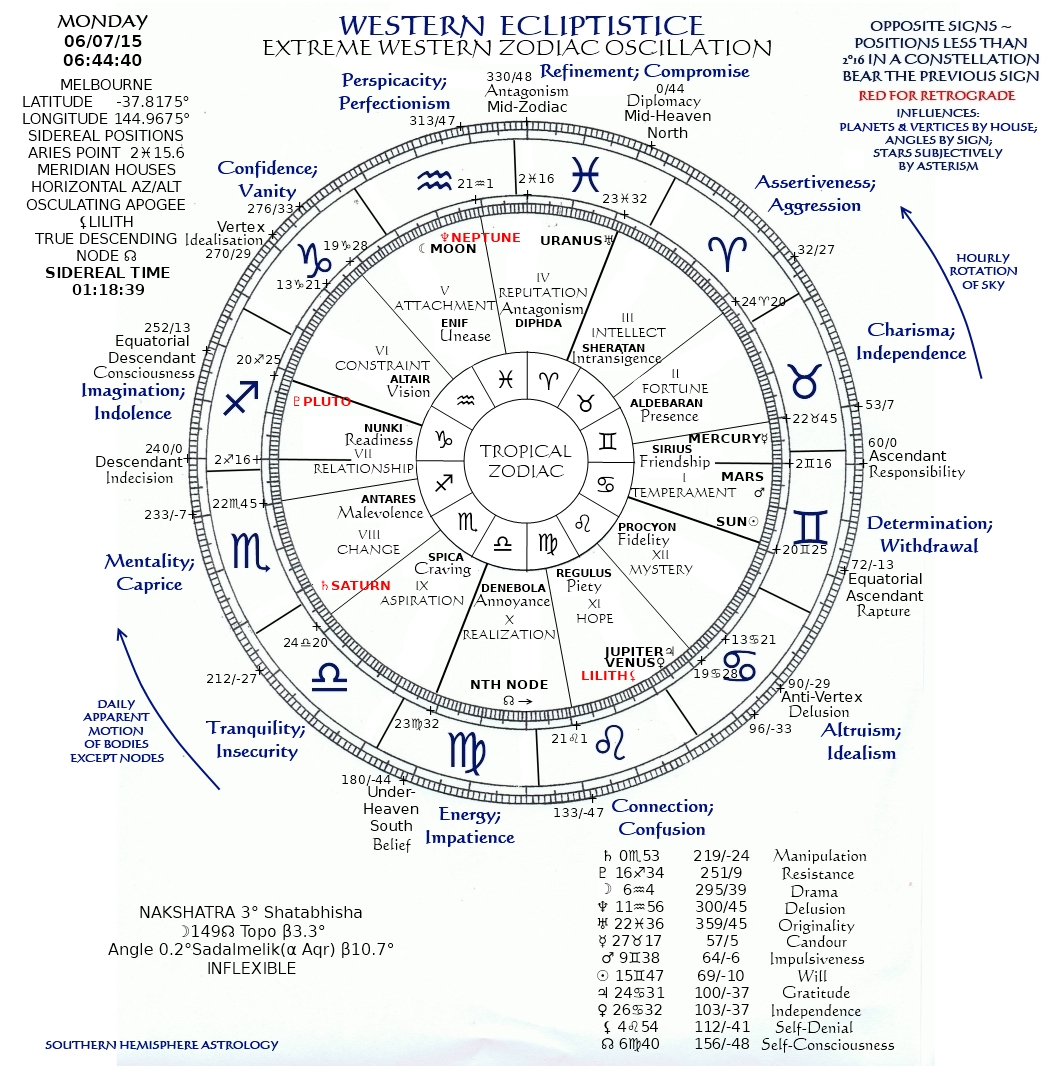
Extreme Western Zodiac Oscillation

There are moments when the world can overwhelm us, when the balance in the mutually-dependant emergence of being out of nothingness swings too far the world’s way.

Nothing epitomises the meaning of the extreme western oscillation of the zodiac better than the alienation from the weekend’s rest and recreation we may be aware of as we return to work on Monday.

Monday morning’s horoscope is for the subjects coming out of Flinders St Station at 6:45am. Fill your shoes, and be of stout heart. Propel the zodiac back towards its balance of the mundane and transcendental. The Southern Hemisphere Astrology Drone encourages you, 20m above your head.WesternEcliptisticeMelbourneJuly06

Altair

Whatever visual impact Altair and Aquila have on an observer facing north they are an imposing sight. In the south the eagle is in mid-plummet, and there is rapacity in its vision. The asterism which leaps to my eye is of a great bird the other way up, but a long-necked bird in uplift like a goose rather than a bird of prey. Aquila from the south looks all the world to me like a fern, the national symbol of the Kiwis, rugged adventurers who make uncomfortable enemies. All of those aspects are milling in the keyword ‘vision’.

The Zodiac Arch and Its Marker Stars.

Stargazing in the south has the potential to confirm the northern resonances of the constellations, because we see them in the opposite season to their conjunction with the sun. The same opposition in the north was I am sure the seed of astrology’s structure of polarities.

On the other hand, conventional astrology in the south continues to assert seasonal resonances on the basis of where the sun is. Can we marry the zodiac’s interplay with personality by season with our experience of seeing the constellations? I don’t know, but I continue to develop a synthesis to that end.

The two most prominent constellation groups in the culture I grew up in were Scorpius and Ophiuchus in winter, and Orion, Taurus and Canis Major in summer. I didn’t focus on Ophiuchus or Canis Major while the scorpion and saucepan were being pointed out to me, but they were in my field of vision, and a definite sense of possession accompanied their dawning familiarity.

I embrace the astrological importance of cardinal directions because they confirm my experience. They are familiar like the great dog and the shield, secrets out of the corner of my eye. Looking east does feel different from looking west, a rising star does have power over a sinking one, and turning west does bring my awareness back, from a quickening of the spirit in the east, to the complexities of my time and place in the world and their eclipse.

This is the basis for my exploration of the resonance of the orientation of the zodiac. If its arc is crowning to the west when I am oriented to the meridian, a different significance imposes itself than what I feel if I have to slew east. The secret I have discovered out of the corner of my eye in this regard is that the stars of the zodiac and its background have a different weight according to whether they are west or east around the crown of the zodiac arc.

It is there for you to discover that the zodiac crowns north at the solstice points, Sagittarius on winter evenings and Gemini in summer, that it is moving west with Sagittarius and east with Gemini, and that it changes direction with Pisces and Virgo as the solstice points rise and set.

It seems to emphasise the extremes of its oscillation by standing still for a month as it changes direction. We have a sol-stice and a luni-stice, and this period could be called an eclipti-stice, when the dim fishes are a ghostly jockey on the back of Pegasus with the wasp of Cetus investigating his rump, or when the diamond facet of Denebola, Arcturus, Spica and Vindemiatrix imposes its irony on the imperceptible outline of Auntie Virgo’s crib.

Have you noticed how long the zodiac seems to be dominated by emptiness? It is not merely that Pisces and Virgo are the zodiac’s largest constellations, but also that they hog the crown for so long.

There is one other phenomenon to tax you with, if you have read to here, and it occurs as Sagittarius tops the arc and then crosses the meridian. At all other times the background stars to the high point of the ecliptic follow each other in succession as they move westward, but at the summer solstice point the midpoint of the zodiac arch moves from third to fourth house, and we couldn’t allow the highest point to trail its marker star behind in a different house, could we?

Accordingly, just before the alignment of ecliptic and equator, we see Scorpius and Ophiuchus move into the fourth house and my marker star becomes Nunki, the vane of the arrow in Sagittarius. The readiness of Nunki is about to be replaced by the vision of Altair, when suddenly the background influence reverts to caution as the midpoint passes into the fourth house now occupied by Rasalhague and Ophiuchus’ unmistakeable outline of a shield (beneath the danger of the scorpion).

All signs have different stellar influences except Scorpio and Sagittarius. You may be unimpressed by this nebulous concern I call a familiar secret, but it just might bear on the characteristics of these two signs, that one faces east and the other west as it crowns, each with the same stellar influence, caution. Perhaps I am an astrologer after all.

Sidereal Resonances

My recent endeavour has been to identify stars which are so spaced apart as never to occupy the same house and so to give the houses an appearance. Appearance is hugely important to a star-gazer arguing against northern hemisphere interpretations of what is in our sky.

As you may know, the simplest house divisions are space-based. They may divide the ecliptic, but then either the orientation to the meridian is lost or the houses are of wildly unequal size.

Alternatively, they may project onto the ecliptic divisions of the prime vertical passing overhead from east to west, but these divisions are very difficult to see.

I use the meridian system, which divides the celestial equator evenly and projects the divisions onto the ecliptic by hour circles, or angles of right ascension. These are easy to see, and to relate to the constellations and the horizon, even if the cusps of the first and seventh houses are usually above or below the horizon.

Customary practice is to locate the planets in the houses according to their ecliptic longitude, so that if the cusp of the fourth house—remember that I number the houses in the order the rising sun passes through them, and the fourth cusp is due north in the visible sky—is at 4Libra say, then a planet at 5Libra is in the third house.

Unfortunately, lines of right ascension and ecliptic longitude are often so divergent in direction that a star or planet in one house appears unambiguously in another. Diphda, only about 21° above the ecliptic and 5Pisces in my zodiac, ‘passes’ the medium coeli when it is apparently 8° east of north. I have failed to identify bright marker stars that evade this problem, and the frequent problem of deciding in which house to place a planet some distance from the ecliptic is notorious.

The obvious solution is to position stars and planets in the houses according to right ascension, and this is what I propose to do. When a body is just east of north it is in the third house and when it passes west of north it is in the fourth. Stars some distance from the ecliptic can and must be visibly reconciled with planets and houses.Politics June 24

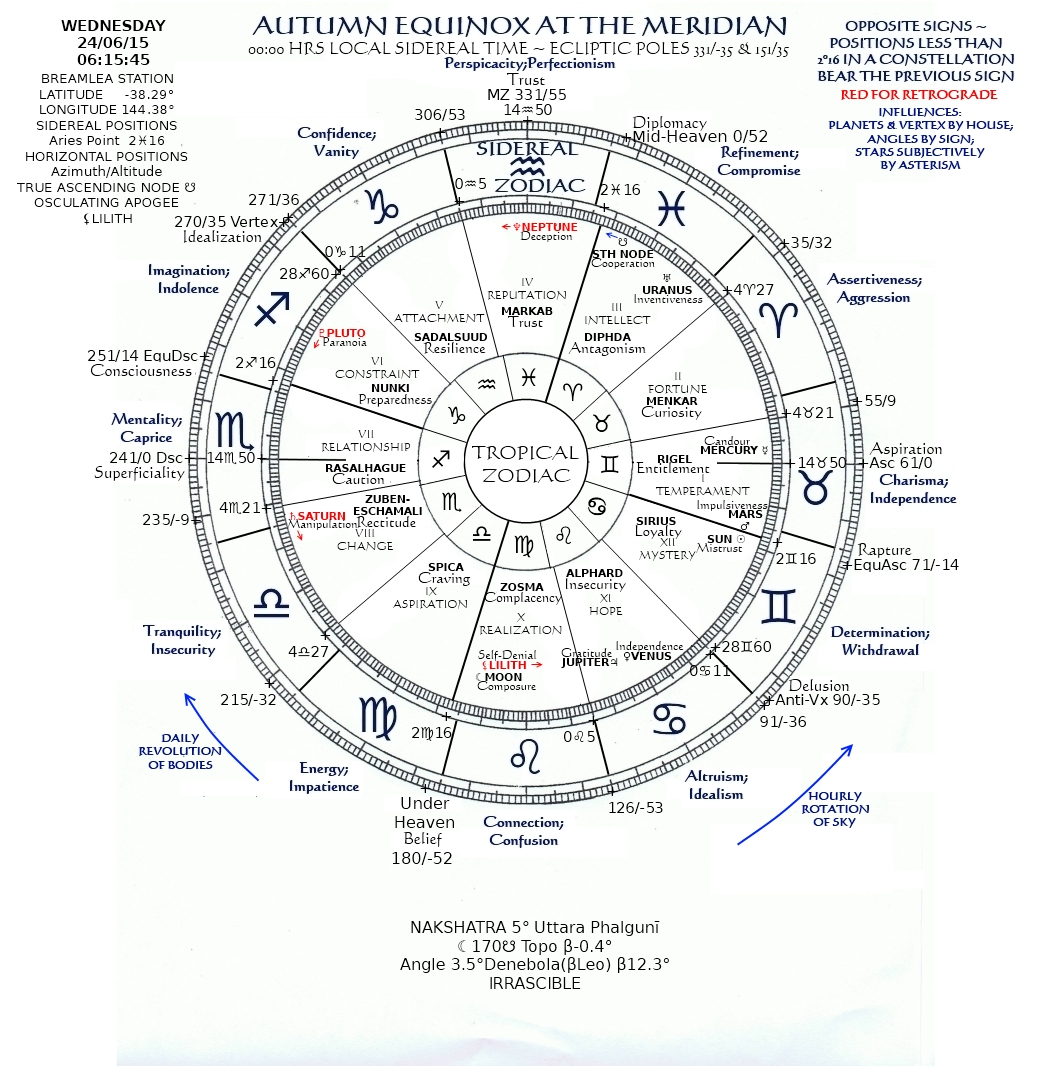
‘Gemini’ and Spring Chronotype South

A week is a long time in astronogy [sic]. Dissatisfied with the anomaly discovered in last week’s chart which loses a sign, I experimented with various combinations of northern and southern hemisphere tropical and sidereal resonances in the quadrants, and concluded that I was losing the plot.By all means, I told myself, disturb immigrated archetypes based solely on bias confirmation, but do it without detracting from the connection with the real sky you’re trying to encourage.

Accordingly, for the present, constellations resonate only with their southern tropical archetypes.

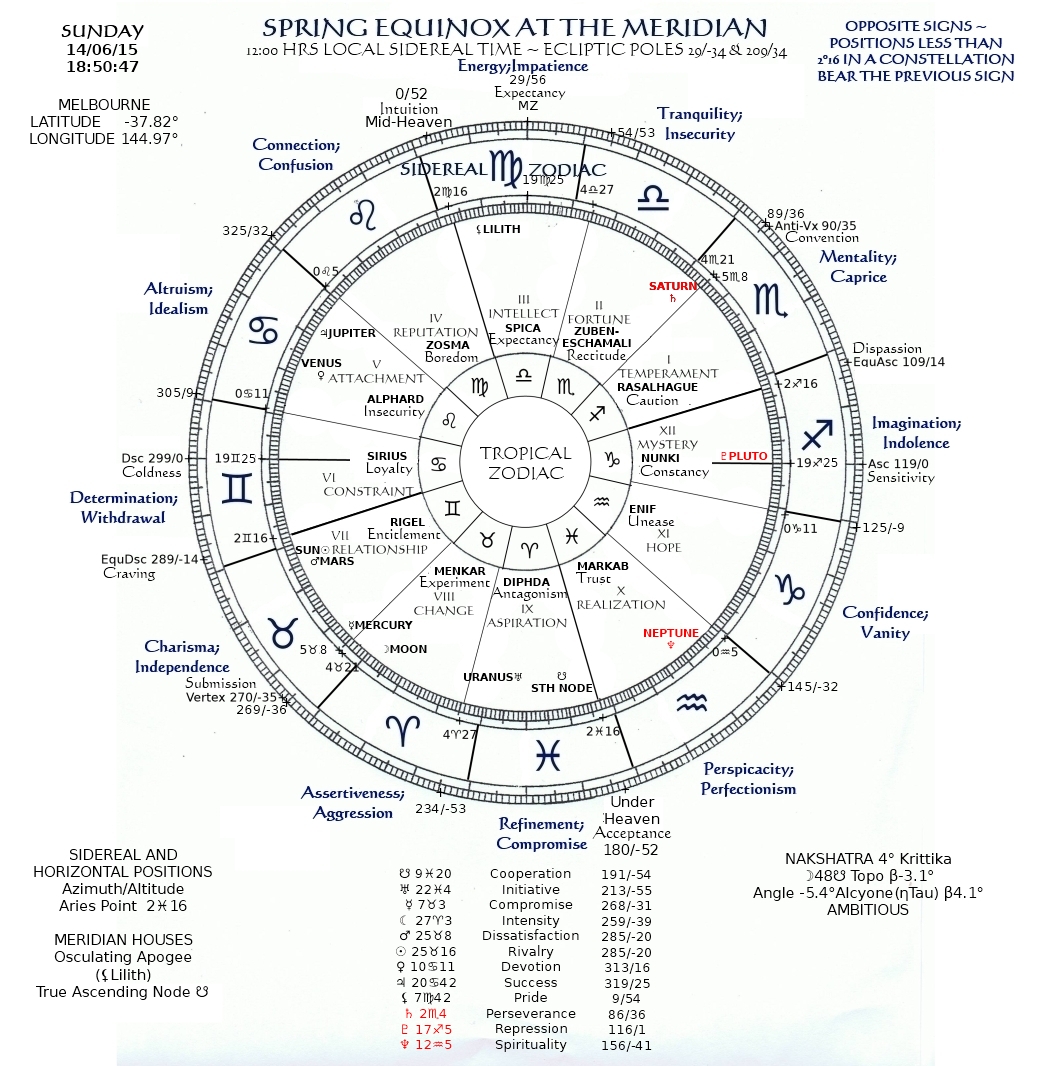
With the series of chronotypes I am drawing your attention to configurations of the daily rhythm of a gyration involving the horizon with the ecliptic and the equator, which may or may not establish a palpable influence on your sensibility.

At the end of this post you will find this week’s Spring Chronotype, whose pulse has phased back into evening twilight and we’re about to progress to the evening culmination of the summer solstice.

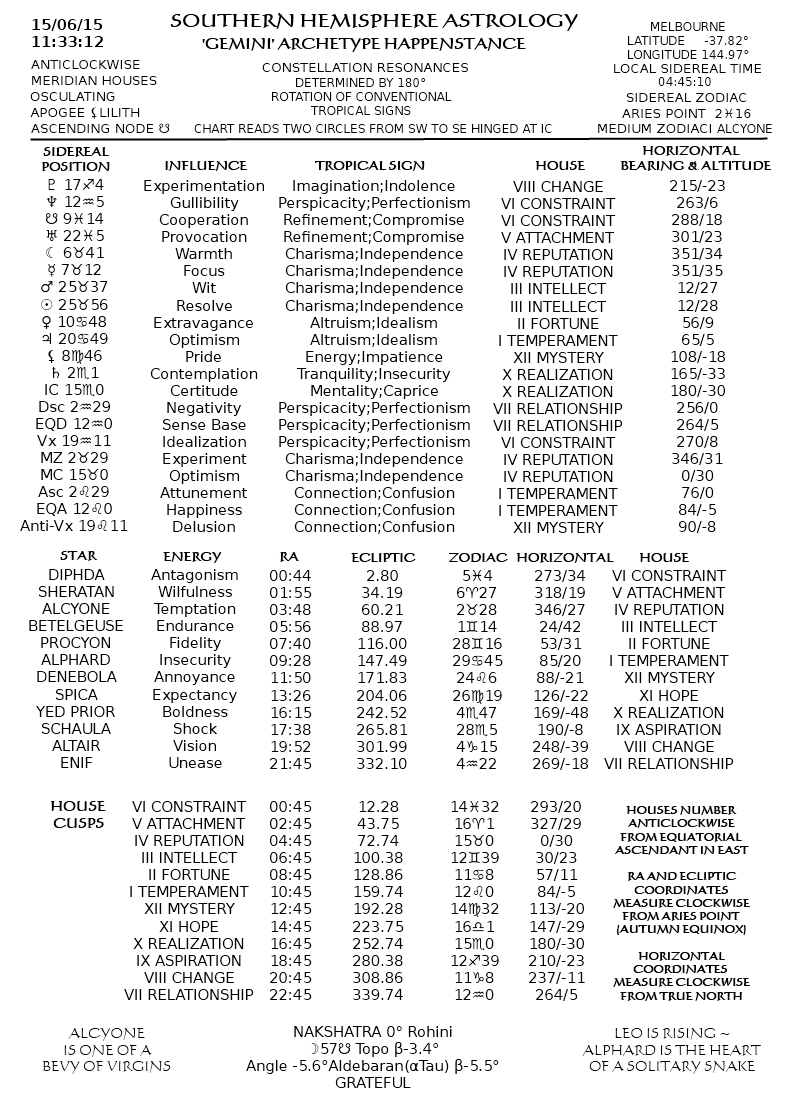
First I want you to look at a synergy of northern and southern tropical interpretations which may cause you to think more seriously about who you are astrologically and who you are not.

First in a series of archetypes, here is ‘Gemini’. Note where you find the recognizable Gemini characteristics in the angles, and how they harmonise with what is actually in the sky. Let me remind you that the IC, the cusp of realization, is what you have to deal with in order to accomplish what is proposed at ‘mid-heaven’ as your highest challenge.GEMINI ARCHETYPE HAPPENSTANCE

And this week’s chart, introducing only southern tropical signs. Enjoy your evenings.SpringMC_Meridian_Jun14